
Managing Up: Influencing Senior Leaders for Safer, Healthier Work
Jul 31, 2026
Dr. Georgi Toma | Director, HeartBrain Works | Honorary Research Fellow, University of Auckland
Introduction
Most WHS and HR professionals have had the experience at least once. You bring a sound, well-evidenced psychosocial risk case to a senior leader, and you walk away with a "not now," a "yes, but there's no budget," or a polite silence that never turns into a decision. The evidence was not the problem. The way it was framed, and the person it was framed for, usually was.
This article draws on a recent HeartBrain Works session on influencing senior leaders. It covers three things: what actually moves the person on the other side of the table, the techniques that turn good evidence into executive buy-in, and what to do when the answer is still no.
Start with what is on their mind, not what is on yours
Before you decide how to make your case, it helps to picture the world the person you are persuading is living in. PwC's 29th Annual Global CEO Survey, which drew on responses from more than 4,000 chief executives across 95 countries and territories, gives a useful snapshot. The concern that topped the list was pace: 42% named keeping up with technology and AI as their leading worry. Confidence in revenue growth was at its lowest in five years, with only 30% feeling confident about it. Cyber attacks were rated a major threat by 31%, up from 24% the year before, and macroeconomic volatility sat at the same level. Inflation, geopolitics, and tariff exposure filled out the rest.
The point of these figures is to help you understand the person you are about to approach. They are likely carrying revenue targets, board expectations, and a long list of risks, and, on older but still telling numbers from the Harvard Business Review, is spending around 72% of their time in meetings. When you arrive with a psychosocial risk issue, you are joining a queue of competing demands. So the first strategy is to know what is genuinely top of mind for your executives, in your context, and to build from there rather than from a generic case.
The five decision-making styles
The third piece of the puzzle, alongside competing demands and high job demands, is that different leaders decide differently. The framework comes from Miller and Williams' research* on persuasion, drawn from work with around 1,600 executives, and outlined in their book called The 5 paths to persuasion. Their central finding is uncomfortable and useful in equal measure: most presentations are aimed at the wrong decision-making style. We tend to prepare for the person we fear rather than the person who actually decides.
Frameworks like this are best treated with a degree of caution. Like any typology, it is a lens rather than the truth, and the aim is to take what is useful and discard the rest. With that caveat, the five styles are:
- The Charismatic (25%) lights up at a new idea but decides methodically, on balanced information, because they have been burned by their own enthusiasm before.
- The Thinker (11%) is the toughest to persuade: cerebral, cautious, and driven by one question, which is how exactly you got from A to B.
- The Skeptic (19%) is suspicious of any data point that challenges their worldview, and the fight can feel like it is about your credibility rather than your numbers.
- The Follower (36%), the largest group and the hardest to spot, does not want the best solution so much as the safest one that has already worked somewhere else.
- The Controller (9%) is driven by a fear of being wrong: they ask for everything, use almost none of it, trust only their own read, and become the bottleneck through which every decision routes.
Reading a leader accurately takes a little discipline, because the clearest signals show up in how they have handled major decisions rather than everyday ones, and because style is not the same thing as personality or how warm someone comes across. Where the signals are genuinely mixed, the safest assumption is the Follower, both because it is the largest group and because precedent, in the form of proof and testimonials, tends to persuade every style. The detailed method for reading a style, and a full profile of each of the five, is where the session goes deepest.
A quiz to figure out which profile your manager is, and the complete profile cards, with strategies for each style, are available to members of the Healthy Work Community of Practice. Each card sets out how to spot the style, what persuades them, their strongest pulls, what not to do, and the single best move to make. A preview of the five is below.
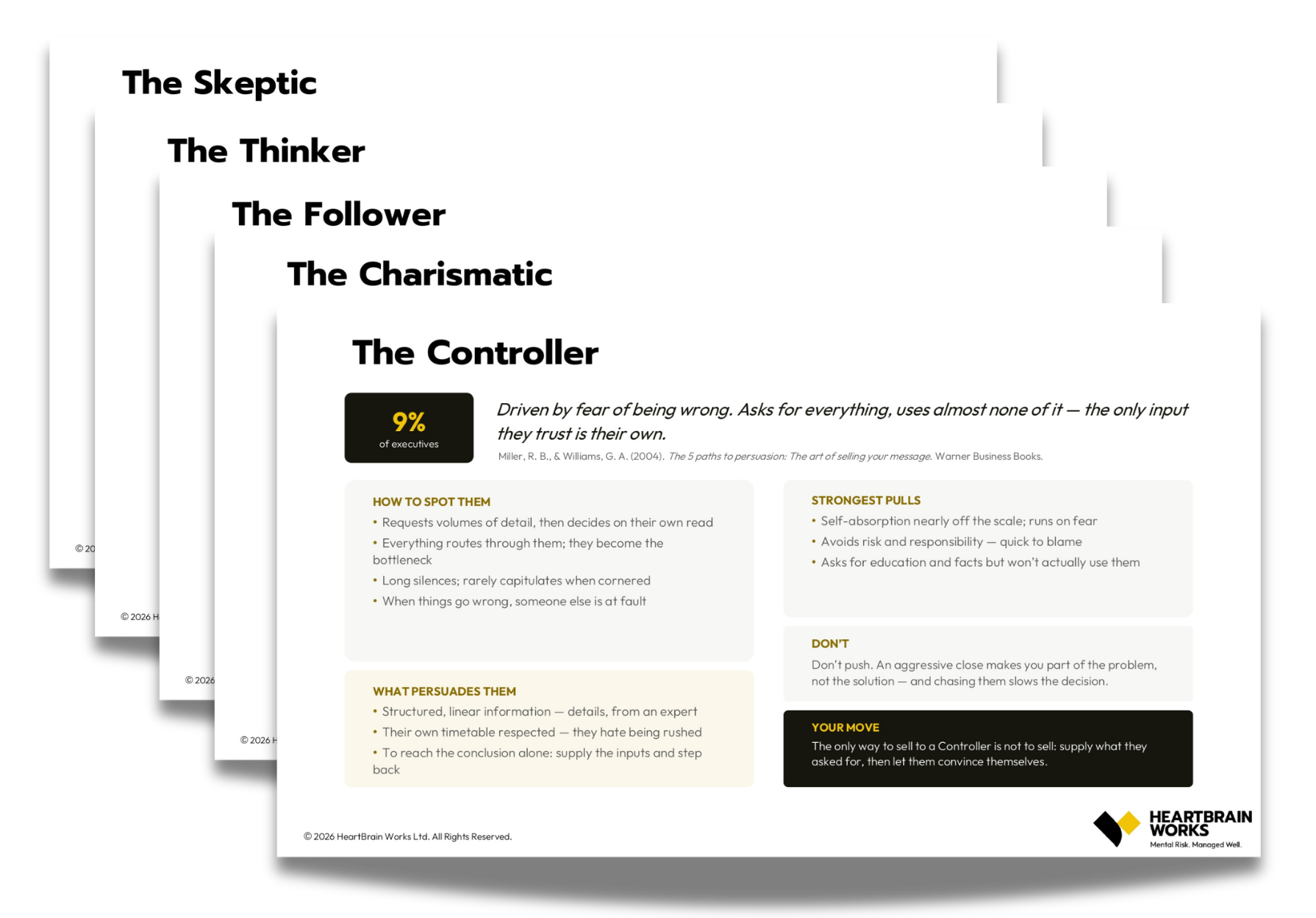
You can access the full-resolution cards, along with the session recording and slides, in the Healthy Work Community of Practice.
The strategic frame: arrive as a solver, not an advocate
Here is where reading the room turns into a plan. When you walk in as an advocate for your function, you are one competing interest among several, and executives are practised at balancing competing interests, usually by deferring them. When you walk in as someone who solves a problem they already have, you stop competing and start being useful. The message does not change. What changes is how you connect it to something that is already keeping them awake.
Hook it to a priority they already have. Do not create a new priority; attach to one already on the strategic plan. At Company X, the practitioner has four natural anchors. If growth is the live issue, the line is something like, "We are expanding this site by 40% next year, and we are losing one in four people within twelve months. That foundation will not support our growth." If cost control is live, the frame is the money already leaking out through turnover, absence, and insurance premiums, before anyone looks for new savings. Reputation is a strong anchor because it ties directly to retention, to Glassdoor and exit-interview themes, and to what a regulator visit would look like. And compliance, the regulatory obligation and officer due diligence, is very useful for starting the conversation, best paired with one of the other three.
Sequence the case: duty, values, ROI. The Mental Health Commission of Canada's case study research found that organisations which successfully implemented psychosocial standards described their motives as practical and ethical: reputation, engagement, employee health, and alignment with values. Direct financial return ranked low. That points to a sequence. Duty gets you the meeting and gets you taken seriously. Values, which is to say reputation, engagement, and doing the right thing, gets you the commitment. ROI, the cost savings and the budget line, is what closes and defends the decision twelve months later.
The due diligence lever. In Australia, psychosocial regulations are now active across all jurisdictions, and the relevant code of practice sets out what a PCBU must do: identify psychosocial hazards, consult staff, assess the risk, identify and implement controls, and review and monitor those controls. Alongside this sits the officer's positive duty of due diligence, which applies to New Zealand as well. An officer is a person who makes, or participates in making, decisions that affect the whole or a substantial part of the business, and they are required to take reasonable steps across six areas: keeping their WHS knowledge current; understanding the operation and its hazards; ensuring resources and processes are available and used to eliminate or reduce risk; ensuring processes to receive and respond to information about incidents and hazards; ensuring processes for complying with duties are in place; and, critically, verifying that the resources and processes in the earlier steps are actually provided, used, and working.
A question worth rewriting in your own words and sharing with your CEO is: if you were asked tomorrow to evidence step six for psychosocial risk, not that we have controls, but that you have verified they are effective, what would you point to? The posture that works is "I am here to protect you from liability, so let me give you what you need to show you have met your due diligence."
Getting funding: trade findings for consequences
Once controls are identified and some of them need money or a work-design change, the framing shifts again. Let's compare two versions of the same finding.
Version A: "Our psychosocial risk assessment found elevated scores for incivlity and low role clarity across three departments." It is accurate, and it is invisible.
Version B: "Two-thirds of our people report experiencing disrespectful behaviour at work in the last year, and the sector benchmark is under a third. In our worst-affected team, nearly half now sit at some level of risk of psychological injury. It is also the team we have recruited into twice this year, with active workers' compensation claims." Same data, with consequences.
Here is the framework used in version B.
- Say what people reported rather than what the factor was called.
- Put your number next to a benchmark, because a figure on its own only invites the question "is that bad?"
- And end on a consequence that is already live for them, swapping the last line for whatever fits: turnover, absence, workers' compensation claims, recruitment cost, delivery dates, regulator attention, or insurance premiums. External data can reinforce the point; the Workforce Institute at UKG, for instance, found that for sixty-nine per cent of people their manager has as much impact on their mental health as their partner or spouse, which reframes manager-support scores as a genuine risk factor rather than a soft one.
Let the screens do the arguing. When every statement maps to something you can show, the argument lands differently. An incivility figure of 65% against a sector benchmark of 31%, a share-of-staff-by-risk-level view for the worst-affected team, a ranked list of psychosocial risks against benchmark: when the sentence you say out loud is backed by a dashboard the executive can see, you are no longer asking them to trust your interpretation. That's why having Alice to display your data, can change the conversation.
Three more strategies
Never surprise an executive in the room. The real negotiation usually happens beforehand, one to one. If a leader hears your numbers or your ask for the first time in front of their peers, they will default to caution. Socialise anything significant privately first, then let the meeting confirm it.
Size the ask as options, not an ultimatum. A single take-it-or-leave-it request invites a no. Two or three sized options invite a choice, and a choice is already a decision. For example: "There are three ways we can do this. A twelve-month pilot in one division at [cost]. The full rollout at [cost]. Or we do nothing further and I bring you an updated exposure assessment in six months. My recommendation is the pilot. What would help most?" It works because the third option names the consequence of declining without threatening anyone; you give a recommendation, so you remain an advisor rather than a menu; and the closing question hands control back to them.
Recruit a champion. Find the one or two executives who already care about mental health, whether as a personal value or a professional priority, brief them properly, and get them to advocate in the room where the decision is made. This matters most when you are presenting to a group with several different decision-making styles. In that situation, get the champion into the room, hold the one-to-one with the main decision maker beforehand, and build a presentation that addresses the biggest concerns of most styles while leaning on the style of the person who actually decides.
When the answer is still no
Sometimes the answer, after all of this, is still no. When it is, confirm it in writing. A short, courteous email that records the risk you identified in the words you used, the advice you gave and the options you offered, and the decision that was made and by whom does two things at once. It protects you, and it quietly re-engages the due diligence lever, because an officer who has been advised in writing can no longer say they were not informed. It is not an act of aggression. It is the natural close of a professional conversation, and it keeps the door open for the next one.
Influencing senior leaders is less about having better evidence than about delivering the evidence you already have to the right person, hooked to a priority they already hold, sized as a decision they can make. Read the style, frame the case, and give them a way to say yes.
If you would like support navigating any of these priorities, we are here to help. Get in touch with us!
About HeartBrain Works
We have supported high-profile clients including Myer, RMIT University, Uber, Hitachi Energy, Clough Group, MEC Mining, and Environment Canterbury to create mentally healthy workplaces. We offer a validated psychosocial risk tool and support to meet compliance, training for leaders and staff, and the scientifically validated Wellbeing Protocol.
About the Healthy Work Community of Practice
The Healthy Work Community of Practice is a professional community for health and safety professionals. Members access quarterly knowledge-sharing sessions, a psychosocial risk controls library, real-world case studies, regulatory alerts, practical toolkits, a job board, research summaries, and ongoing training and workshops. Intake opens three times per year. To learn more, visit https://www.heartbrainworks.org/Healthy-Work-CoP