
SESSION REPLAY
Live Knowledge Sharing Session
Psychosocial Risk Management in Practice
What is a Knowledge-Sharing Session?
Each quarter, members of the Healthy Work Community of Practice come together to analyse a real case study, discuss emerging challenges, and explore effective approaches to psychosocial risk management.
In this session, a fictionalised scenario based on real client work and recent psychosocial prosecutions in Australia was used to work through hazard identification, risk assessment and the hierarchy of controls.
THE CASE STUDY
Scenario: Tech Solutions Company
Tech Solutions Company is a fast-growing AU software company with approximately 320 employees across Sydney and Brisbane. The company provides enterprise SaaS products to financial services clients and has recently secured a Series C funding round, bringing with it aggressive growth targets and pressure from investors to achieve profitability within 18 months.
The company uses a performance management framework that includes quarterly “stack rankings” where employees in each team are rated on a forced distribution curve: the top 20% receive bonuses, the middle 60% receive standard reviews, and the bottom 20% are placed on formal Performance Improvement Plans (PIPs). Employees on PIPs are given 90 days to meet specified metrics, with termination as the stated consequence for failure.
Three engineers in the Brisbane office have been placed on consecutive PIPs over the past six months. One of these employees, who had consistently received positive feedback from direct peers and clients, was placed on a PIP after a restructure changed his reporting line to a new manager. During the PIP process, the employee’s requests for clarity on the performance metrics were not addressed, and scheduled check-in meetings were frequently cancelled by the manager. The employee has since been diagnosed with a major depressive disorder and is on extended leave.
The company has an EAP and a mental health awareness page on the intranet, but no psychosocial risk assessment has been conducted, and the performance management framework has never been evaluated through a WHS lens.
4 psychological injury claims have been lodged in the past 9 months, all from employees who were either on PIPs or had recently exited PIPs. The claims consistently cite “unreasonable performance management,” “lack of support,” and “bullying disguised as performance feedback.”
An internal engagement survey showed a 23-point drop in the “psychological safety” score over the past year. Free-text responses included comments like: “I’m terrified of being in the bottom 20%,” “the PIP process is used as a weapon, not a development tool,” and “my manager uses the ranking to punish people who disagree with them.”
Several team leaders have raised concerns with HR that the stack ranking system is creating a competitive rather than collaborative culture, and that employees are hoarding knowledge and refusing to help colleagues for fear of being outperformed. HR’s response was that “the system drives high performance and is endorsed by the board.”
SCENARIO ANALYSIS
1. You're the new WHS manager or HR lead. What would you do?
Identify 2 immediate actions and 2 medium-term actions.
Immediate actions example
- Escalate to the board — prepare a concise report presenting the data (injury claims, sick leave, engagement drop) alongside WHS legislation, flag the potential breach of officer duty of care, and request an immediate pause on all active PIPs.
- Targeted welfare response — reach out to impacted employees outside their reporting line, provide confidential support, and begin planning return-to-work arrangements that do not reinstate the PIP.
Medium-term actions example
- Conduct a psychosocial risk assessment — no assessment exists. This is a clear legislative requirement.
- Present findings to the board with a business case for redesigning the performance management framework entirely.
Note: navigating internal politics, finding an executive sponsor, managing the relationship with HR, is a recurring challenge in psychosocial risk management and a topic covered in upcoming CoP training.
2. What psychosocial hazards might be present in this scenario?
The following psychosocial hazards were identified as present in this scenario:
- Poor organisational justice
- High job demands
- Poor reward & recognition
- Bullying
- Low role clarity
- Poor support
- Poor organisational change management
- Conflict & poor workplace relationships
- Job insecurity
3. How would you assess risk?
We covered a three-step manual risk assessment process for psychosocial hazards. This approach was based on Dr. Georgi Toma's upcoming book: Psychosocial Risk Management for a Healthier Workplace - A Practical Implementation Guide.
The process involves several steps, each with it's own matrix.
4. What controls could be put in place, applying the hierarchy of controls?
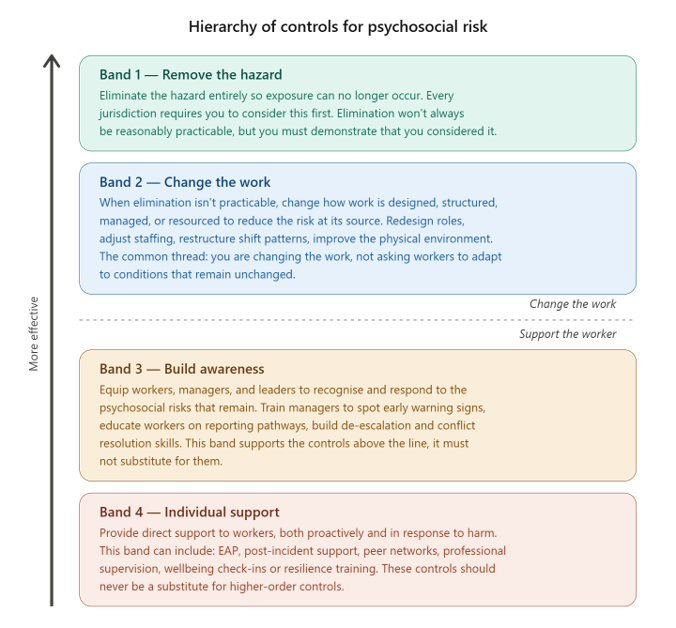
We applied HeartBrain Works' four-band hierarchy of controls for psychosocial risk, moving from most effective (eliminating the hazard) to least effective (individual support). Bands 1 and 2 change the work; Bands 3 and 4 support the worker.
This Hierarchy has been adapted from WorkSafe Victoria's regulations (2025), as well as New Zealand Government Health and Safety's adaptation of the hierarchy of controls to psychosocial risk (2024).
Controls examples
Band 1 . Eliminate
- Eliminate the forced distribution / stack ranking model entirely
- Eliminate the use of PIPs as a quasi-termination mechanism (separate developmental performance support from disciplinary processes)
- Eliminate any performance metric that requires workers to be ranked against each other rather than against role expectations
Band 2 . Change the work
- Redesign performance management around developmental coaching against role-specific expectations, with collaborative goal-setting, scheduled mandatory check-ins, and clear documentation
- Rebuild PIPs (if retained as a developmental tool) with procedural justice embedded: jointly agreed metrics defined up front, mandatory weekly check-ins that cannot be cancelled by the manager alone, right of review by an independent party, separation from automatic termination
- Standardised reporting-line transition protocol — when a restructure changes who someone reports to, mandate a calibration period before any performance action can be initiated by the new manager
-
Recalibrate growth and profitability targets against psychosocial risk capacity.
-
Redesign reward systems to recognise collaboration and knowledge-sharing, not just individual ranking
-
Embed psychosocial risk indicators in board reporting alongside financial KPIs
-
Independent escalation pathway for performance decisions that workers believe have not been managed reasonably
Band 3 . Build awareness
- Manager capability training on procedural fairness, performance coaching, psychosocial risk
- Officer training for the board and executive on due diligence as it applies specifically to psychosocial risk
- HR capability uplift on WHS framing of people practices
- HSR training on psychosocial hazards and consultation rights
- Worker education on reporting pathways and psychosocial hazard awareness
Band 4 . Individual support
- Targeted return-to-work support for the engineer on extended leave, coordinated with treating practitioners, with explicit commitment that PIP will not resume on return
- Active outreach to current and recent PIP-affected workers with confidential support outside the reporting line
- Strengthen and de-stigmatise EAP
- Peer support network
What this scenario demonstrates
The Tech Solutions Company scenario illustrates how a single structural decision, a forced distribution performance framework, can generate a cascade of psychosocial hazards across an entire organisation. What presents on the surface as a performance management issue is, under WHS legislation, a failure of psychosocial risk management at the systems level.
Several features of this scenario are common in real workplaces: an EAP is in place, engagement surveys are being run, and some stakeholders believe the system is working. Yet none of these measures were functioning as controls. The EAP did not address the source of harm. The engagement data was not being acted upon. And the performance framework had never been evaluated through a WHS lens.
The key insight from applying the hierarchy of controls is that individual support alone is insufficient. Band 4 responses: EAP, peer support, return-to-work coordination are necessary but cannot substitute for eliminating or redesigning the system that is causing harm in the first place.
About the Healthy Work Community of Practice
The Healthy Work Community of Practice is a professional community for health and safety professionals. Members access quarterly knowledge-sharing sessions, a psychosocial risk controls library, real-world case studies, regulatory alerts, practical toolkits, a job board, research summaries, and ongoing training and workshops. Intake opens three times per year.
To learn more, visit Healthy Work Community of Practice.
Meet members of the Community & hear their experience
JOIN NOW
Join now and experience in depth knowledge sharing sessions every quarter.
Registration open until 9th of June 2026.
A$440 per year
NZ$500 per year